Showing posts with label sermons. Show all posts

30/01/2026

Sunday of the Publican and the Pharisee


Luke l8: l0-l4
By His Eminence
Metropolitan Panteleimon of Antinoes
It was very characteristic of our Lord Jesus Christ that in order to teach the Divine Truth, He used examples taken from the daily life of His times. In this way He was able to help those who believed in Him to apply the Divine Truth in their own lives.
In the Parable of today's Gospel, our Lord showed us two different types of men, who both went up to the Temple to pray. He also mentioned a very significant point, their different religious and social class. The first was a Pharisee and the second a Publican.
Now, amongst the Jews of the time, there were different religious parties. The most important of these were the Pharisees, who were strict observer of the Law of Moses; the Sadducees who believed that there is no resurrection; the Ninevees, who were dedicated to God, and the Essenes, who were ascetics.
The Pharasees boasted that they followed the Law of Moses literally. They wore special clothes and could always be easily recognised in a crowd of people. Το use the words of our Lord, "they do all their deeds to be seen by men; for they make their phylacteries broad and their fringes long, and they love the place of honour at feasts and the best seats in the synagogues, and salutations in the marketplace, and being called rabbi by men" (Matt. 23:5-7). They separated themselves from the rest of the people, believing themselves to be the just in the Eyes of God. The Publican on the other hand, belonged to a group who were hated and despised by rich and poor alike.
As we saw in last Sunday's sermon, the Publican’s job was to collect taxes. However they did not stop at collecting the tax that was legally due to the Roman Empire, but imposed heavy surcharges which went into their own pockets, and which were a crushing burden for the people to bear. But they were especially hated and despised not only for their corruption, but for the fact that they collaborated with the Romans.

05/05/2018

8th Sunday of St Luke The Good Samaritan


(Luke 10:25-37)
By
His Eminence
Metropolitan Panteleimon of Antinoes

A certain man was traveling from Jerusalem to the city of Jericho. He was a peaceful and hard working man, who was struggling for his daily bread and caring about his family. On his way, he suddenly fell into the hands of thieves. What can anyone expect to follow? They stripped him of whatever he had, they mistreated him with cruelty, they wounded him and abandoned him in the midst of the desert, lying down in his own blood and half dead without any help.  
In today’s Holy Gospel reading our Lord and Saviour Jesus Christ, the Son of God, gives us the example of the suffering man, who fell in the hands of evil thieves. He was stripped from every good thing that he possessed. He is the man, who departed from the sacred law of God and was abandoning the holy city of God, Jerusalem, in order to go to the city of sin, Jericho. Thus, he brought upon himself the sufferings which he endured.
The priest and the Levite, although, are close to the scene and they have seen what had had happened, yet, they do nothing! They do not want even to look upon the man and they leave him and depart in a hurry! They flee from the crime scene! They flee from their duty! This is what many typical religious people do today: They, who suppose to be religious, are in reality only typically. They are those people who, through religion, seek worldly glory from men, instead of seeking the glory which is offered by God. They live not according to the Orthodox Christian Faith and virtues, but in accordance of their own vain glory, self-love and self-satisfaction.
Today, how many times we see the sufferings of our fellow man? How many times we hear the sigh and we notice the tears of the ones who are in pain and suffering, and we abandoned them, saying: “I have no time for them”, in order that we do not miss our pressure and valuable time!  Or, in order that we won’t spend few of our money! Or, in order that we might not get tired and suffer for the sake of our fellow man! Thus, we depart from the crime scene and do not perform our good and righteous duty.

23/07/2017

St. Panteleimon, the Great Martyr.


His Eminence Panteleimon Metropolitan of Antinoes


St Evouli (the mother of ) St. Panteleimon – St Hermolaos (his teachers)

            During the end of the 3rd century AD St. Panteleimon, the Great Doctor and Martyr, was  born.  His father, Eustrogios, was not only very rich but was well known for his zeal in idol worship; whereas his mother St. Euboule was a faithful Orthodox Christian full of Holy Spirit, love and kindness.  Her only interest was to guide her only begotten son in the true faith and virtuous life. 

            St. Panteleimon's first name was Pantoleon.  When he was very young his mother, St. Euboule, passed away and his father taught him to worship the false gods of their ancestors.  He studied under the guidance of the wise doctor Euphrosynos, and shortly differentiated from all his other classmates in wisdom and all virtues.  Even the Roman Emperor Maximianus admired his kind character, that he ordered Euphrosynos to teach him all the secrets of medicine, so that Pantoleon become his own personal  imperial doctor. 

            At that period of time, in the Greek city of Nicomedia, there was an old man named Ermolaos, who was the Orthodox Priest of the city.  He foresaw, that the young Pantoleon will become a vessel of Christ's Grace and will glorify Him through his life.  One day, as Pantoleon was passing by, he called the young doctor to his house and asked him about his family and religious beliefs.  Pantoleon, as noble as he was, answered with politeness to all his questions.  St. Ermolaos said to him, that the medicine which Asclepius, Hippocrates and Galenus taught is of no value, nor the gods of the Empire are true gods, but false and work of man. He taught Pantoleon about the Orthodox Christian Faith and that Christ is the only True God, Who created heaven and earth, and reminded him that his mother believed in Jesus Christ.  He also emphasied that Christ is the True Physician of both soul and body and  assured him, that if he believed in Christ, he shall cure all illnesses through God's Healing Grace.

03/04/2013

Second Sunday οf Lent St. Gregory Palamas


By
His Eminence
Metropolitan Panteleimon of Antinoes
On the second Sunday of Lent our Church commemorates St. Gregory Palamas, who played a leading role in the triumph of Orthodoxy at a very difficult time in its history.
St. Gregory was born in the Emperor's palace in Constantinople. He grew up there and was educated as a prince. Although the Emperor showered favours on him and established him in a high position, St. Gregory's heart leaned towards Christ. For this reason he left the palace at an early age and went to Mount Athos to become a monk.
His stay on Mount Athos enabled him to go deeply into the writings of the Fathers and to experience the fruits of the Prayer of the Heart.
The “Prayer of the Heart” or the “Jesus Prayer” is that of the Publican, "Lord Jesus Christ Son of God, have mercy on me a sinner", is a prayer that is repeated constantly and which has as its aim the cleansing of the heart of all thoughts and desires, so that he who prays, may with the Grace of God, experience the Divine Light.
The Divine Light is uncreated and is revealed only after great and intense spiritual struggle, which the monk undertakes under obedience to his Abbot or Spiritual Father. It is the same light that the three Apostles, namely Peter, James and John, saw on Mount Tabor, when our Lord was Transfigured before them. His face becoming as radiant as the sun and His clothes as white as snow. The vision of Divine Light may be vouchsafed to any Orthodox Christian who sincerely strives to clean his heart, soul and body, of all unclean thoughts and desires, thus becoming a true temple of the Holy Trinity. Our Lord promised that He would come down and make His abode in the heart of any man who loves Him and keeps His commandments.

To the 2nd Salutations to the Theotokos


By
His Eminence
Metropolitan Panteleimon of Antinoes

            The incarnation of “Christ’s presence” was for man’s history the miracle of all miracles, the greatest of all miracles. Man because of his fall day by day was alienated from his God and Creator. AS time was passing, he was going down to the path of catastrophe. The heart of the fallen man was infected and his will was crushed.
            From the ruins of man’s moral and spiritual condition, the joyful sound of the angelic hymns was heard, glorifying “the presence of Christ’s incarnation”.  The Word and Son of God is incarnated and becomes perfect man. God descends from heaven to raise man to heaven. The Son of God takes up all the human nature in order to make man a god. God the Word, who created man in the “image and likeness” of God, vests Himself with that which He Himself had created. The Son of God humbles Himself in order to correct the pride of His creation.
            This incarnation of “Christ’s presence” was the saving solution which God provided to save man. Man by his own was unable to be saved and to restore his relationship with God. All men were guilty of sin. No one was just, so that he might offer the unique Sacrifice which was required “for the world’s life and salvation”.

24/02/2013

16th SUNDAY OF ST MATTHEW THE TALANTS (Matth. 25:14-30)


By
His Eminence
Metropolitan Panteleimon of Antinoes


In today’s Gospel reading, our Lord and Savior Jesus Christ spoke about the Parable of the Talents. He brings us before a serious subject, which concerns each and every one of us. Every man has been gifted by God with various talents, different charismata, various skills. These talents one must concern as gifts from God, who entrusted them to us so that we will give an account to God.
St. John Chrysostom, interpreting the Parable of the Talents explains, that with the term “talent” our Lord Jesus Christ means the abilities and skills of each and every one of us to practice every good deed with responsibility. So, if we hold an official public position, or we have a special place in society, or if we have been blessed with wealth, or we are gifted with capability of knowledge and teaching, or with whatever other spiritual gift, All the “talents” are God-given.
According to the Parable, the “talents” are given by God to man. But, in Holy Scripture God calls men generally as His children, but here He calls them “servants”. This God does in order to reveal, that we are responsible before Him, and that we should obedient in a perfect way; not because we are considered as “servants”. But, because God’s Law is perfect and beneficial to all. He who follows God’s Law becomes truly free and offers himself to perfect obedience to God. Even our Lord Jesus Christ became the prototype example for all faithful. For us He became a “servant”, and humbledHimself so much, and became obedient to the Divine Will till death. “Who, though he was in the form of God, did not regard equality with God as something to be exploited, 7 but emptied himself, taking the form of a slave, being born in human likeness. And being found in human form, 8 he humbled himself           and became obedient to the point of death— even death on a cross” (Phil. 2:6-8).
The Parable’s lord gave the talents to his servants and immediately departed to a country far away. God gives us His Talents, then various gifts, but never stands over us as a despot or tyrant to force us in any way, but He leaves us to use our talents freely as we wish. If we do not use them properly, then although He continuous to respect our free will, He shows mercy and patience till the moment when He will return to demand an account from us.
The talents are given in order to be used with responsibility, as we will give an account. Time goes by and we will give our account. This account is necessary and Christ assured us many times that it will take place (see Matth. 18:23-24; Luke 19:11-26).
But, if thetalents are ours, then why should God demand an account from us? The skills might be ours, but we have them from God. Our skills our either naturally, or they have been given by the Grace of the Holy Spirit, consequently, they are from God. For this reason our Lord in the Parable says, that the lord gave his belonging to his servants. The charismata which we have, we must see them as belongings of God, which have been given to us by God. Thus, we should use them as divine gifts and use them and increase them to a perfect level, according to God’s instructions.
Our Lord Jesus Christ Himself recognized this obligation for Himself, as He considered as His duty to preach the Kingdom of God to all the cities and country side.
The responsibility for our deeds and use of our talents and skills is generally for all of us. Our Lord assured us that each of us will give an account according to his works (Rom. 14:12).
This understanding that one day we will give an account should guide us throughout our lives. Our skills, small or big, should be used with great responsibility. It is not enough to do something, but we should struggle to increase the talents. Woe, to that person who had received a talent and he hid it!
Let us accept with humbleness and gratitude the various talents and charismata and let us struggle to multiply them for the glory of our True God, the Holy Trinity. Amen.

08/02/2013

St. Haralambos the Martyr


By
His Eminence
Metropolitan Panteleimon of Antinoes

 "As pillar unshaken of Christ's Holy Church and lamp ever-burning to all the world, you emerged, O wise Haralambos. In all the world you shined with the martyrdom you suffered. You dispelled the dark night of the idols O blessed. Thence with daring do intercede to Christ that we may be saved." (Tone 4)

"You therefore, my son, be strong in the grace that is in Christ Jesus. And the things that you have heard from me among many witnesses, commit these to faithful men who will be able to teach others also. You therefore must endure hardship as a good soldier of Jesus Christ. No one engaged in warfare entangles himself with the affairs of this life, that he may please him who enlisted him as a soldier. And also if anyone competes in athletics, he is not crowned unless he competes according to the rules. The hardworking farmer must be first to partake of the crops. Consider what I say, and may the Lord give you understanding in all things…" (2Timothy 2:1-7)

In the early Church, the term "martyr" was originally used when characterizing the Apostles as witnesses of Christ's life and resurrection [Acts 1:8, 22]. Due to the persecutions that the early Christians endured, however, the term was applied to those who gave their lives for the Christian Orthodox Faith. In Greek, the word martyr means "witness" and, the verb form, martyred, means to "bear witness" or "give evidence."

Though martyrdom was not a constant experience for the early Church, it was a possibility with which the early Christians had to reckon. It was the consummate act of faith for as the Lord said: "Greater love has no one than this, than to lay down one’s life for his friends" (John 15:13). Before actually being executed, however, the martyr usually endured extreme physical and moral sufferings.

28/01/2013

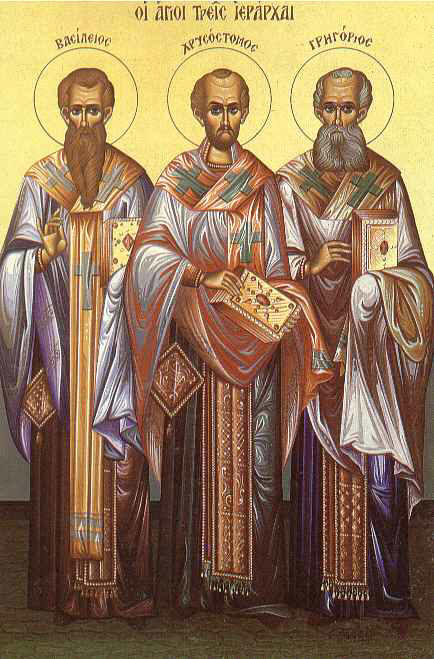
Tο the three Hierarchs 30th January


By
His Eminence
Metropolitan Panteleimon of Antinoes
In order for us to understand the role and importance which the holy Fathers have within the life of the Orthodox Church, we must examine it under the light of the Divine Economia. But, what to we mean when we speak about “Divine Economia”?
Divine Economia is the entire work of salvation. It is the realization of God’s Will concerning man’s salvation. Man, because of Satan’s envy, was led to disobey the Divine Commandment with the result that sin entered into the world and through sin death ruled. St Gregory the Theologian teaches, that ‘God created man, because He was not satisfied moving within His own vision, but His Love had to be outpoured to other creatures.’ God wanted to raise man from the condition of innocent, ignorance and the lack of experience of good and evil, and lead him into the knowledge and free choice of good. But, the disobedience towards the simple Commandment of God brought upon mankind dramatic consequents.
The direct communion of man and the Grace of God ceased. Man was left to his own powers, deserted in the world of carnal passions, which became his nature’s master and tyrant. Man’s mind was darkened and his conscience became weak, disfigured and became hardened to such extent that he was unable to distinguish the unholy and evil from the holy and good. Man’s will lost its power and became a slave to evil desires. Love was replaced by pride, selfishness and hatred. The truth was replaced by lies; the True God was abandoned and His place was taken by the numerous false gods of idolatry. These were the few fruits of man’s apostasy and departure from God.

25/01/2013

Sunday of Zacchaeus


Luke l9: l-l0
By
His Eminence
Metropolitan Panteleimon of Antinoes
The Son and Logos of God had one basic aim, namely the salvation of mankind.  Man wandered far from the true knowledge of God and was anxious to find the truth which would guide him to salvation and the longed for union with his Creator.
Man’s mind and heart were darkened by sin, and as a result he did not attain to divinity as promised by the serpent in Paradise, "and the serpent said to the woman, you will not die. For God knows that, when you eat of it your eyes will be opened, and you will be like God, knowing good and evil" (Gen. 3:4-5), but the consequences of disobedience to God’s Commandment were catastrophic for mankind.
St. Paul in the epistle of Romans teaches us: ''Ever since the creation ofthe world his invisible nature, namely, his eternal power and deity, has been clearly perceived in the things that have been made. So they are without excuse; for although they knew God they did not honour Him as God or give thanks to Him, but they became futile in their thinking and their senseless minds were darkened. Claiming to be wise, they became fools, and exchanged the glory of the immortal God for images resembling mortal man or birds or animals or reptiles. Therefore, God gave them up in the lusts of their hearts to impurity, to the dishonouring of their bodies amongst themselves, because they exchanged the truth about God for a lie and worshiped and served the creature rather than the Creator, who is blessed for ever" (Rom. l:20-25).
More and more man gives his attention to material things rather than to things of spirit, and in his heart puts matter above all. He enslaves himself with matter and his inordinate desire for riches and material things often causes him to be unjust.
Man, drunk with greed, always wants more and more. Nothing satisfies him. He uses any and every means to increase his possessions with complete indifference to the needs and claims of his fellow men; he doesn't care if he exploits others; he doesn't care how other men are to live. The cries of the women he oppresses fall on deaf ears. Confronted with the hungry faces of children this cruel man feels nothing; his onlΥ aim is to be rich.

18/01/2013

12th Sunday of St Luke Sunday of the Ten Lepers


(Luke 17:12-19)

By His Eminence
Metropolitan Panteleimon of Antinoes
 
Leprosy in the past was considered an incurable illness which was vanished from Europe only during the last decades of the 20th century.
Death was slow and accompanied with great pain. The lepers were seeing their body’s parts decaying, rotting and breaking off, and their faces deforming. The worst of all was their isolation and loneliness. No one was allowed to approach them, for the danger that they might be exposed to the illness. But, even, if they had the courage to surpass this fear, then, only the view of their wounds was enough to scatter away even the closest and most beloved relatives. They were as living dead, awaiting death as their only deliverance.
Ten lepers, among so many thousands, condemned to continuous isolation, hopeless of any human help, had only one hope. They have heard about Jesus of Nazareth, the Teacher who was God sent and performed miracles. But, their problem was, how to meet with Him. They could not approach the cities or villages and for this reason the Lord Who knows the secrets of men’s hearts, guides Himself to the territory of the ten lepers. 
      The Ten lepers stood from a distance and with a loud voice the cried out: “Jesus, Master, have mercy on us!” The Lord, regardless of His tiredness, stood with great compassion and replied immediately to their request: “Go and show yourselves to the priests”, in order that they may, according to the Mosaic Law, confirm your healing. As they went their way towards Jerusalem, the miracle took place. The leprosy was cleansed. Their body’s parts were restored and healed; new skin appeared and covered their wounded bodies.  The miracle was completed. Now, one should wait to see all ten to return back to Jesus with joy, to give thanks. But, unfortunately, the nine did not return to give thanks to their benefactor. Only one as grateful enough to return and he was a Samaritan. The one who was a stranger to the Jewish nation returned and felt down to the ground to show his appreciation.

07/01/2013

SUNDAY AFTER CHRISTMAS


  By   His Eminence Metropolitan Panteleimon of Antinoes 
“Herod seeks to kill the Child”
The events which followed the Nativity of our Lord, as these appeared in the Holy Gospel of St. Matthew, describe the path which the Messiah will follow in His worldly life. The new born Infant of Bethlehem experienced, right from the beginning, the hatred of men and that of the rulers of this world.  The events which were realized by Herod the King, confirm the truth of the above words as these are witnessed by the historians of that period.
Christ’s appearance in the world created new and true ways of life for man, which directs him to the one path which offers him salvation, meeting the descending Love of God. It is a progress which all the demonic powers are crushed and man is able to embrace the authentic messages which the Divine Infant of Bethlehem sends.
It might seem that Satan’s power still rules over mankind, with all its consequences; but, its prevalence is deceptive and temporary. And this takes place because in history the divine work of salvation is realized and no one is able to prevent it or cancel it. Neither, Herod’s inhumanity and aggressiveness which were revealed with the slaughtering of the innocent infants at Bethlehem and the surrounding region weren’t able to cancel the work of the new born Messiah Who was under the protected Providence of God.

22/12/2012

SUNDAY BEFORE CRISTMASS


                                                                                                                             By   His Eminence Metropolitan Panteleimon of Antinoes

Through the Old Testament’s prophesies, the Lord Almighty prepared mankind to receive the Messiah, Who would be God Incarnated. He would had dwelt and lived amongst men. God promises Moses, that He will built His tent amongst the people of Israel, and that He will be their God and they will be His people (Lev. 26:11, 12). The prophet Isaiah, more than any other prophet, foretold that God will take up human flesh and, as the God-Man, will live amongst men. Even the name ‘Emmanuel’, which was given by the Angel means: God is with us.
Man cannot know how God became man. Man’s mind cannot understand the depth of this “great mystery”, in other words, how God was incarnated as a perfect man and simultaneously His human nature had received the fullness of the Deity within it, without the two Natures being confused or mingle or mixed.
God the Word took up all the human nature, but without sin. The human nature is receiving all the Hypostasis of God the Son and Word and at the same time the Son remains inseparable from the Father and the Holy Spirit, filling all Creation with His Divine presence. He is presence not in partial, but as the whole God in all Creation and in all parts of the Creation. To this All-presence of the Word of God the term “Emmanuel” is expressed, which means God is with us.
The presence and dwelling of God amongst men is the presence of salvation and the source of God’s Gifts and Charismata. The presence of God the Word in man’s history was an offering of redemption, which man so desired and could not find on his own. God the Word with His Incarnation brought the Heavenly Kingdom of God to men and is extended in eternity. God had to come in a physical manner to enlighten man’s mind through His Teachings. With the sanctification of the human nature, Christ could free it from the bondage of the sinful passions. Man’s mind and heart would have been cleansed from the stain of sin and he would become free from the tyranny of guilt and death itself.
With the Incarnation of the Word man’s relationship with God the Father has been restored and men are worthy to become, through Grace, ‘sons of God’. The Incarnation of the Word of God opened Paradise and ended the authority of Satan. For the Nativity in Bethlehem of Judaea had to take place, in order that the Sacrifice on Golgotha be realized.  
Mankind, after the Fall of the first-created, was enslaved completely to sinful passions. Men’s hearts were turned to evil from their youth. Human nature was so much disfigured and corrupted, that God had decided that His Spirit will not rest amongst men, because of their sinfulness. With the Sacrifice, which was offered by Christ, all those who believe in His name, are no longer slaves, but His friends and co-heirs in His Heavenly Kingdom.
The presence of the Lord within the Orthodox Church is eternal. Emmanuel, the Son of God, the Son of the Ever-Virgin Mary, is within and remains within the Church and grants to all Orthodox faithful salvation till the ends of time.
How many times did not our Lord and Saviour Jesus Christ called the men of His time and still continues calling all men to accept His Teachings? The Feast Day of Christ’s Nativity has approached. How many of us have prepared accordingly to receive Christ within our hearts?
We all have been busy with the cleaning of our homes! We all ran to make our Christmas shopping’s, to prepare Christmas sweets, to buy new clothes and festival gifts! In all these, how many of us have prepared the inner part of our souls to receive the Heavenly Infant of Bethlehem? How many of us have turned our thoughts towards our brothers and sisters who truly have the need of our support? How many have forgiven those who trespassed against them? How many of us ran and participated in the Holy Sacrament of Confession and cleansed their souls from their daily sins?   
But, my beloved brethren, how many families also cry and suffer during these holy days, because many gamble? Men, who worked throughout the year, in few moments gamble and find themselves penniless, unable to buy even the basic food for their homes? And, for all these problems the reasons rely in the passion of wanting to win more and more money. Greed blinds their thoughts and enslaves their hearts, with the hope of a quick way of becoming rich. How great pain we cause to the Infant Christ during these days. When instead of going to the Church, we prefer to stay at home or at the casino?
Christ is born in the hearts of men, when we open our hearts to Him and invite Him with true faith and love. Christ is born and man is reborn.
Beloved, on the occasion of the coming great feast of the Incarnation of the Son and Word of God, let us decorate our souls with true faith and good deeds, in order that Emmanuel will dwell within our personal life and we become the living temples of His love. Amen.

17/12/2012

11th Sunday of St. Luke The Great Banquet


By
His Eminence
Metropolitan Panteleimon of Antinoes

«A man made a great banquet and invited many».

Our Lord and Saviour Jesus Christ, the Son of God, many times used parables in order to make the people understand the heavenly truths which He revealed. Thus, today, He used an image from the daily life, in order to reveal the importance of man’s participation in the banquet which is offered by God’s Love, the Holy Sacrament of the Divine Eucharist.

Before us lays a banquet. A great banquet, which is offered by God. It is a banquet which the Wisdom of God invites all men saying: ‘Come, eat my bread and drink wine, which I offer to you”. It is a banquet of which Prophet King David had spoke of: “You have prepared before Me a banquet contrary to those who make Me sad; You have anointed My head with oil and Your cup I drunk as the most best”. It is a great banquet which is offered for our salvation by the Lamb, the Son and Word of God. A great banquet, in the midst of which the Heavenly Lamb of God invites everyone saying: “come, for all is prepared”.

            In the midst of the Holy Sacrament of the Divine Eucharist the extreme Love of God is expressed, Who “desires that all men to be saved and to come to the knowledge of truth” (1 Τim. 2:4).  The special characteristic of God’s Love towards man is the offering and the sacrifice. He who loves sacrifices everything for him whom is loved. He, who loves less, offers less. But, he who loves more, offers even more. Our Lord Jesus Christ extremely loved “His own in the world”, and for this reason He offers Himself “for the life and salvation of the world”. St. John the Evangelist speaking about the greatness of this divine love says: “Thus God loved the world, that He gave His own begotten Son, so that whoever believes in Him shall not parish, but have eternal life” (John 3:15-16).

20/11/2012

THE ENTRANCE OF THE THEOTOKOS


21st November

By
His Eminence
Metropolitan Panteleimon of Antinoes


          The Entrance of the Ever Virgin Mary and Theotokos in God’s Temple is considered to be one of the most important events in the History of Salvation.  All the Orthodox Church around the world is celebrating the Entrance of the Mother of God, the Theotokos and Ever Virgin Mary, into the Holy of Holies.

          The faithful and all the heavenly Powers conjoin and concelebrate. Earth rejoices and the faithful Orthodox Christians gather to honor with all piety and respect the all praised Mother of our Lord and Saviour Jesus Christ, the Son of God. We venerate the holy icon of the Theotokos. With a humble and broken heart all those who suffer address their prayers to Her, in order to express their needs and beseech Her protection and help. All true faithful will bless Her, they shall sing hymns to Her and all generations will glorify Her. The Mother of God and Ever Virgin Mary, the Theotokos, is the source of our sanctification and salvation, for She had gave birth to the incarnated Son and Word of God.

          The Entrance of the Ever Virgin Mary consist the preparation of the salvation of mankind. She enters the Holy of Holies, where only the High Priest was allowed to enter only once a year. The Prophet Zacharias, the father of St John the Forerunner and Baptist, and many young virgins receive Mary, when she was only three years of age, dedicated to God by Her parents Joachim and Anna.

The Mother of God, Mary, enters the Holy of Holies, where She was honored to become the living Ark and Temple of God.  She is been fed by Archangel Gabriel with heavenly food. She enters the Holy of Holies, where She surpassed in holiness the holiness of all the Angelical Hosts. She enters the Holy of Holies, as a golden censer, for She had conceived within Her holy womb all the Fire of the Deity. She enters the Holy of Holies, as a golden jug which contains the Heavenly Manna, the Heavenly Bread, the God-Man Jesus Christ. She enters the Holy of Holies and She nurtures the Creator and Provider of all the World.  

13/11/2012

5th Sunday of St. Luke


By His Eminence Metropolitan Panteleimon of Antinoes
THE PARABLE OF THE RICH MAN AND THE POOR LAZARUS
Luke 16:19-31

The Parable of the Holy Gospel does not refer to the Second Coming of Christ, neither to His Last Judgement, but to the period of time between man’s death and the Second Glorious Coming of Christ our Lord and God. This period is called:  The Middle Condition of the souls.
           What is death?
           Death, according to Holy Scriptures, is the separation of the human’s soul from his body. Death was not created by God right from the beginning, but came as the result of man’s Fall, disobedience and unrepentance (Gen. 3:9-13). “And unto Adam He said, because thou hast hearkened unto the voice of thy wife, and hast eaten of the tree, of which I commanded thee, saying, Thou shalt  not eat of it: cursed is the ground for thy sake; in sorrow shalt thou eat of it all the days of thy life; thorns also and thistles shall it bring forth to thee; and thou shalt eat the herb of the field; in the sweat of thy face shalt thou eat bread, till thou return unto the ground; for out of it was thou taken: for dust thou art, and unto dust shalt thou return”(Gen. 3:17-19).
           Death has three forms:
 a)                Physical Death, occurs when the body stops functioning biologically. The soul is separated from the body (Gen. 3:19) “And it came to pass, that the beggar died, and was carried by the angels into Abraham’s bosom; the rich man also died, and was buried” (Luk 16:22).

21/10/2012

6th Sunday of St Luke


 (Luke 8:26-39)
By His Eminence Metropolitan Panteleimon of Antinoes
            As our Lord and Savior Jesus Christ visited the villages of Judaea, he met a man from the village of Gergeseen. Now, this particularly man few years ago became possessed by many demons, who made him suffer in many ways. The possessed man was in a wild condition, the result of the demons’ influence. He was ripping off his clothes and was living in the tombs of the dead. Although his relatives were tiding him up with chains, in order that he will be unable to harm any other human being, he was breaking his chains and was led by the demons into the wilderness.      
            In this miserable condition our Lord and Savior Jesus Christ, the Son of God, meets with the possessed man. The appearance of the possessed man is pitiable and frightful. Yet, the Merciful Lord walks into the wilderness in order to meet with His troubled creation, man. He meets with him and opens a dialogue with the unclean spirits, which with His Divine authority casts out and banishes them away from His creation.
            The Work of Salvation of our Lord and Savior Jesus Christ had as its final goal to free man from the bondage and the tyranny of the evil one, Satan. With man’s fall into sin, day after day, year after year, he was drifting far away from God, falling more and more into the traps of the enemy. Mankind became enslaved to the devil. The peak of this tyranny is achieved, when man is possessed by evil spirits.
            When the evil spirit posses man’s soul, then it rules over both his soul and body, in other words man’s whole existence. Man acts whatever Satan tells him to do, without having understanding of what he says or does. Man’s soul and conscience are paralyzed by the evil forces and are unable to react against them. Man lives the greatest misery of his existence.
            Our Lord and Savior Jesus Christ, for the love towards man, came to free him. He came to meet with every man. He came to discuss with us and to guide us back to God the Father.

20/10/2012

Sunday of the 7th Ecumenical Synod


By His Eminence Panteleimon Metropolitan of Antinoes

In the year of our Lord 726 AD, the Emperor of Byzantium, Leon III Isauros, influenced by the heretical teachings of the Nestorians and Paulicians, who opposed the use of holy icons, forbidden the veneration of the holy icons. But this imperial decision was not accepted by the majority of the Orthodox people of the Byzantine Empire. The reaction of the Orthodox faithful reached its peak, when the Emperor ordered to remove the miraculous holy icon of Christ the Savior, which was above the palace’s main entrance. This action was considered as an act of high treason. Thus, from that moment the iconoclast period began and lasted more than 120 years.
The heresy of iconoclast doesn’t refer only to the prohibition of the veneration of the holy icons, but it was a wide religious and ecclesiastical reformation. The iconoclasts refused not only the veneration of the holy icons, but also that of the holy relics of the holy Saints, their intervention and those of the holy Mother of God, the Ever Virgin Mary and Theotokos.
 The Orthodox people rebelled and, having as their leader someone called Kosmas, gathered an army and sailed against the capital city of Constantinople. Unfortunately, Leon III, as a skilled general and Emperor, managed to overtake the rebellions, captured and beheaded Kosmas. From that day Emperor Leon III enforced the general prohibition of the veneration and use of holy icons. He raised a cruel persecution against anyone who was a friend of the holy icons. The Orthodox Empire entered into a period of struggle which lasted more than 120 years. The people were divided into iconoclasts (those who destroy the icons) and those who were friends of the icons.    
            Numerous martyrs and confessors gave their lives defending the true teachings of the Orthodox Church concerning the holy icons, the holy relics and the interventions of the holy Saints. Many scholars, Bishops and Monks, wrote books clarifying the true meaning of the veneration of the holy icons. They distinguished between the worship which is offered only to God and the honoring veneration which is offered to the holy Saints, who are in reality the true friends of Christ. Among those who defended the holy icons are St John of Damas, St Basil the Great, and St Theodore Abbot of the Monastery of Studite.

08/10/2012

3rd Sunday of St Luke


The resurrection of the widow’s son of Nain
(Luke 7:11-18)

By
His Eminence
Panteleimon Metropolitan of Antinoes

            When death occurs it saddens our hearts. For man was not created by God to die; but, was created with the possibility of not dying. If Adam never had disobeyed God’s Commandment in the Garden of Delight, death would never occurred and man would participated in an eternal life here on earth. Man would never had to face pain, sufferings, mortality and finally death, which became his greatest enemy, because of the Fall and the Disobedience to God’s Commandment.
            In today’s Gospel’s reading, we see before our very eyes a mother who accompanies her only begotten son to its tomb. The whole picture moves our hearts. The mother with great pain in her soul accompanies the fruit of her womb to its final resting place. She is surrounded by many people and, yet, she remains by herself with the only thought, the lost of her precious child, who was her only comfort in life as she had lost her husband some time ago.  
            The situation is dramatic. During this hopeless time, the moment, when she preceded towards the tomb, unexpectedly Christ meets with her. Christ meets with the dead young man and changes the course of life. The Source of Life confronts with the death of His creation, and with authority He commands saying: “Young man, I say to you, rise” (Luke 7:14). Immediately, “the dead sat up rise” (Luke 7:15).
            The people of Nain were filled with sacred fear, a deep astonishment and an indescribable admiration, when they witnessed this sensational miracle. They had seen and heard about the many miracles which the Lord had performed. But, this, which took place before their very eyes and only by His commandment, was stunning. They witnessed a dead man being raised from the dead. They saw a fellow countryman, who they thought that was for ever lost, coming back to their society alive and in good health.

30/09/2012

2ND SUNDAY OF ST LUKE


CONCERNING LOVE
By His Eminence
Panteleimon, Archbishop of Antinoes

            Man is by nature a social being. He lives, moves, acts and develops within a society of human beings. Right from the beginning of Creation, God Himself noticed, that “is not good for man to be alone upon the earth”, and thus He forms the woman taken out from one of Adam’s ribs, fulfilled the missing flesh and thus presented Eve to Adam, to be a helpmate for him. In other words, God Himself created and then blessed the society of man. Our ancestors, the Greek philosophers, said: “A man, who does not live with other fellow men, either has to be a god or crazy”. 
            The Triune God is social, because He is Three: Father, Son and Holy Spirit. God is One in His Essence, but Three in His Hypostases or Persons. (Hypostasis means the way of existence). Among the Three Persons an absolute and perfect harmonious relationship exists. None of the created things in the whole Universe, either visible or invisible, knows that which is of the Father, but only the Son; and no one knows that which is of the Son except of the Father. The Holy Spirit searches the depths of the Father’s Essence.
            The Love of the Three Persons is mutual and it is expressed towards the world, especially towards man. Love is from God, and anyone who loves his neighbor is from God and knows God. He who does not have love, does not know God, because God is Love (1 John 4:7-8). He, who struggles to remain in the love towards his fellow man, partakes of the love of God and God dwells in the heart of that person who has love. For this reason, if God has loved us so much, we also must love one another in a similar manner (1st John 4:11).
            Love is the connection link in our relationships with our fellow man. The question of today’s Gospel reading is: Do we love correctly? Is our love that love which God demands from us, pure and unconditional? Is our love distinguished from the worldly love?    

23/09/2012

1st Sunday of St. Luke. (Luke 5:1-11)


By: His Eminence  Metropolitan Panteleimon of Antinoes

 
            In today’s Gospel reading St. Peter with the rest of the holy Apostles were astonished at the catch of fish which they had caught.  Christ our Lord had sat in St. Peter’s boat and was teaching the people.  The Disciples had worked very hard all night long, but they had caught nothing.  St. Peter at the commandment of Christ let down the net and then God’s blessings came, for "they caught a great number of fish" (Luke 5:6).
           
Obedience to God’s Will is man’s first and foremost duty.  Second most important is to carry out His Divine Commandments.  The godly man strives to conform himself to whatever God wishes.  Man through obedience to God identifies himself with God, and his will with God’s Divine Will.

            The holy Apostle Peter at the greatest moment of his difficult hours of disappointment and depression, showed obedience to Christ.  The result is obvious.  God blesses the work of all those who struggle with honesty.

            In our daily struggle to survive there are some moments, when we feel let down.  Many times despair and dissolution overcome our hearts, when we hope for some things that do not come right. 

            How many times do we turn to God and not see any results?  Did God not hear our prayers? Is He relaxing in His Heavenly Kingdom and does not care for us? No! The answer to these questions lie in that we must not only turn to God, but we must also learn to trust God.

            St. Peter not only accepted Christ in his fishing boat, but also showed absolute obedience to His commandment.  Without a second discussion he threw the nets into the shallow waters of Gennesaret.  Because of his obedience God blessed his work.

            Now, how many times does it happen in our life that we accept Christ not in our boat, but in our hearts, but we are not obedient to Him?  How many times do we say that we believe in the Lord, but, yet, we have not made the effort to bow and humble ourselves before Him?  How many times do we pray to God, but within our hearts we do not learn to trust Him? How many times do we find ourselves in difficult situations and we ask for God’s help and assistance, but in reality we do not believe in His Providence? How many times do we believe that God will interfere, like magic, to fulfil our wishes?  Finally, how many times, when we see no results of Divine intervention, we turn away from God?

            St. Peter was blessed, because he showed obedience to Christ.  God’s blessings came as the result of Peter’s obedience to His Will.  The miracle at Gennesaret came about because of St. Peter’s faithfulness. St. Peter knew very well, being an experienced fisherman, that there could be no fish in the shallow waters of Gennesaret.  All night long he worked with his collaborafors and, yet, they caught nothing.  But, he showed obedience to Christ’s word and he let down the nets. For Christ’s sake he did not hesitate. He did not say, that ‘We are wasting our time’.  He just obeyed and trusted Christ’s word.